


Job placement and careers

Their dual expertise in data science and applied fields (economics, finance, insurance, social sciences, quantitative marketing, etc.) is particularly sought after.
Combining technical excellence, a cross-functional perspective, and analytical skills, graduates assist public and private organizations in leveraging data and making informed decisions.
Banking, finance, insurance, consulting, industry, the public sector, or entrepreneurship: their skills open up opportunities in a wide variety of sectors, both in France and internationally. With the rise of digital technology and the growing use of data, these career opportunities continue to expand far beyond traditional sectors.
Illustration with the ENSAE Class of 2025
A survey on labor market integration among ENSAE Paris engineering graduates, conducted in 2026 using the methodology of the CGE (Conférence des grandes écoles) among graduates from the last three graduating classes.
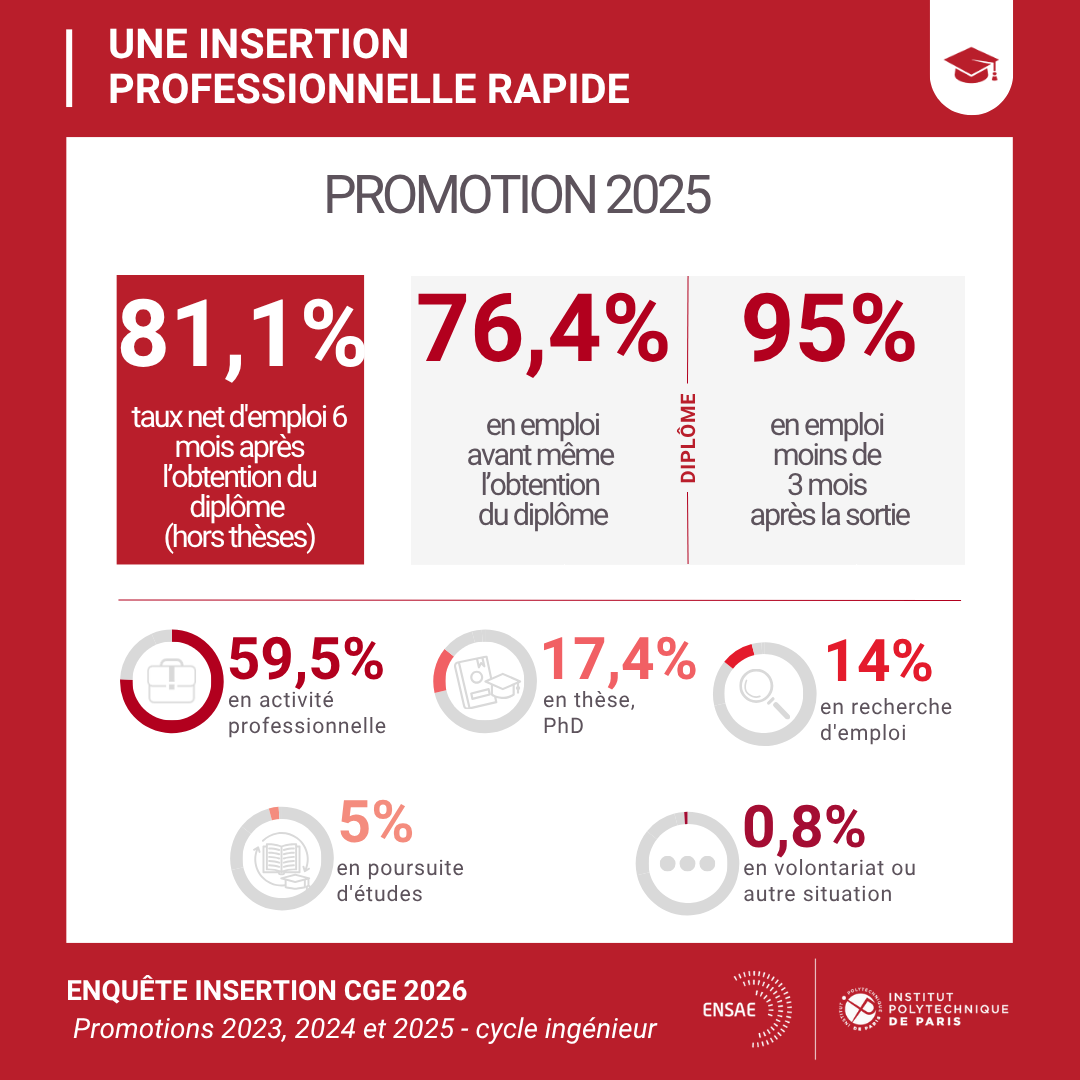
In a labor market environment that is less favorable than in previous years, the Class of 2025 graduates are demonstrating true resilience. The net employment rate six months after graduation (excluding those pursuing a Ph.D.) stands at 81.1% for the Class of 2025 graduates. This reflects the strength of medium-term career prospects for ENSAE Paris graduates. If students pursuing a thesis are counted as employed, the 6-month rate rises to 84.7%.
Pursuing a thesis accounts for 17.4% of the Class of 2025 graduates.
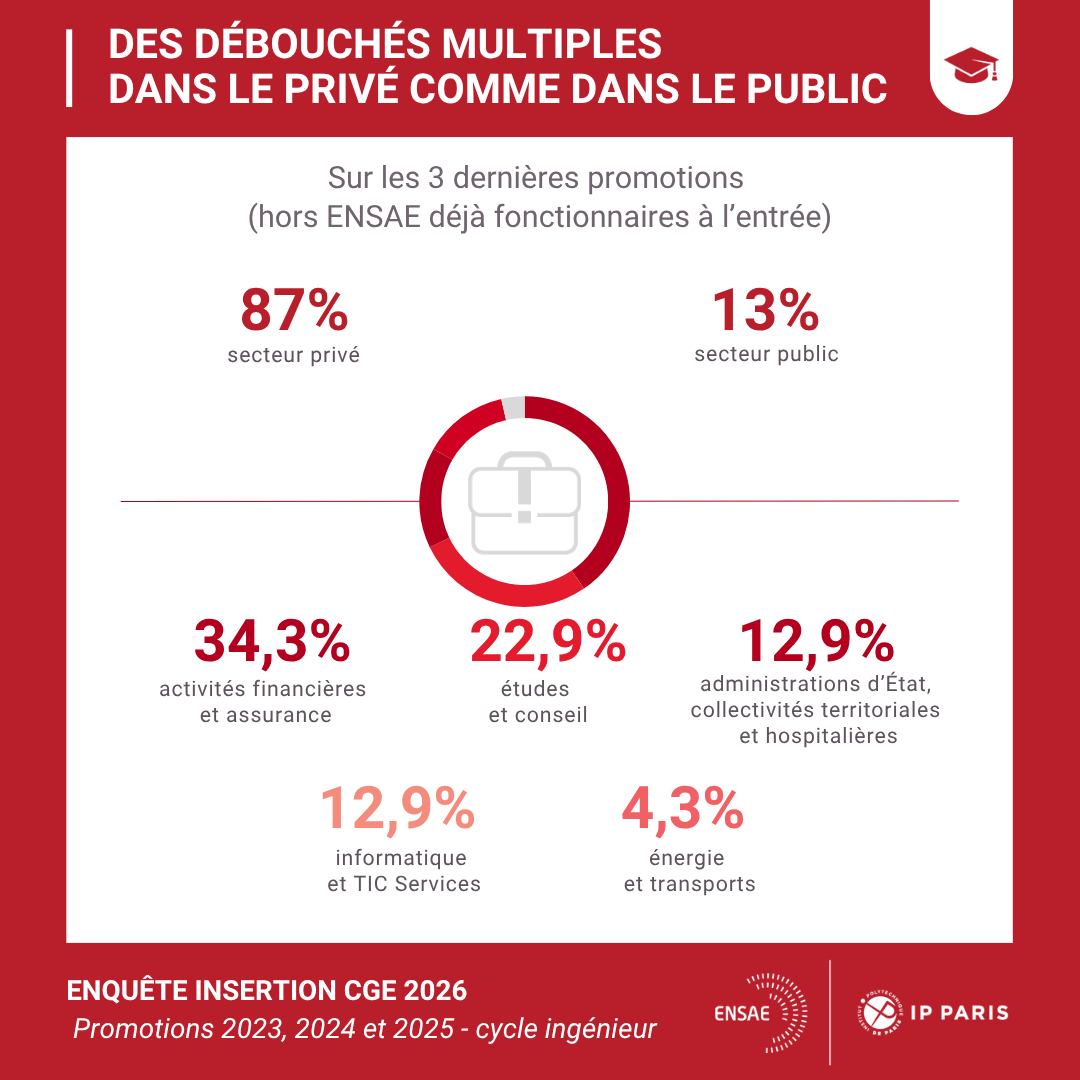
Nearly all employed graduates from the Class of 2025 are salaried employees. The private sector remains the leading employer, while the public sector continues to be a consistently attractive option. The survey does not include civil servants.
In terms of industry, finance and insurance remain the top sector, employing nearly 35% of the Class of 2025 graduates. The research and consulting sector remains at a fairly high level, accounting for 23% of graduates. State and local government agencies account for 13% of job placements, and IT and information services (ICT Services) also account for 13%.
Despite challenging economic conditions, ENSAE Paris graduates continue to enter the workforce in remarkably short time frames.
Among the graduates from the most recent class who are currently employed, 76% found a job even before graduating, and 95% found one within three months of graduation.
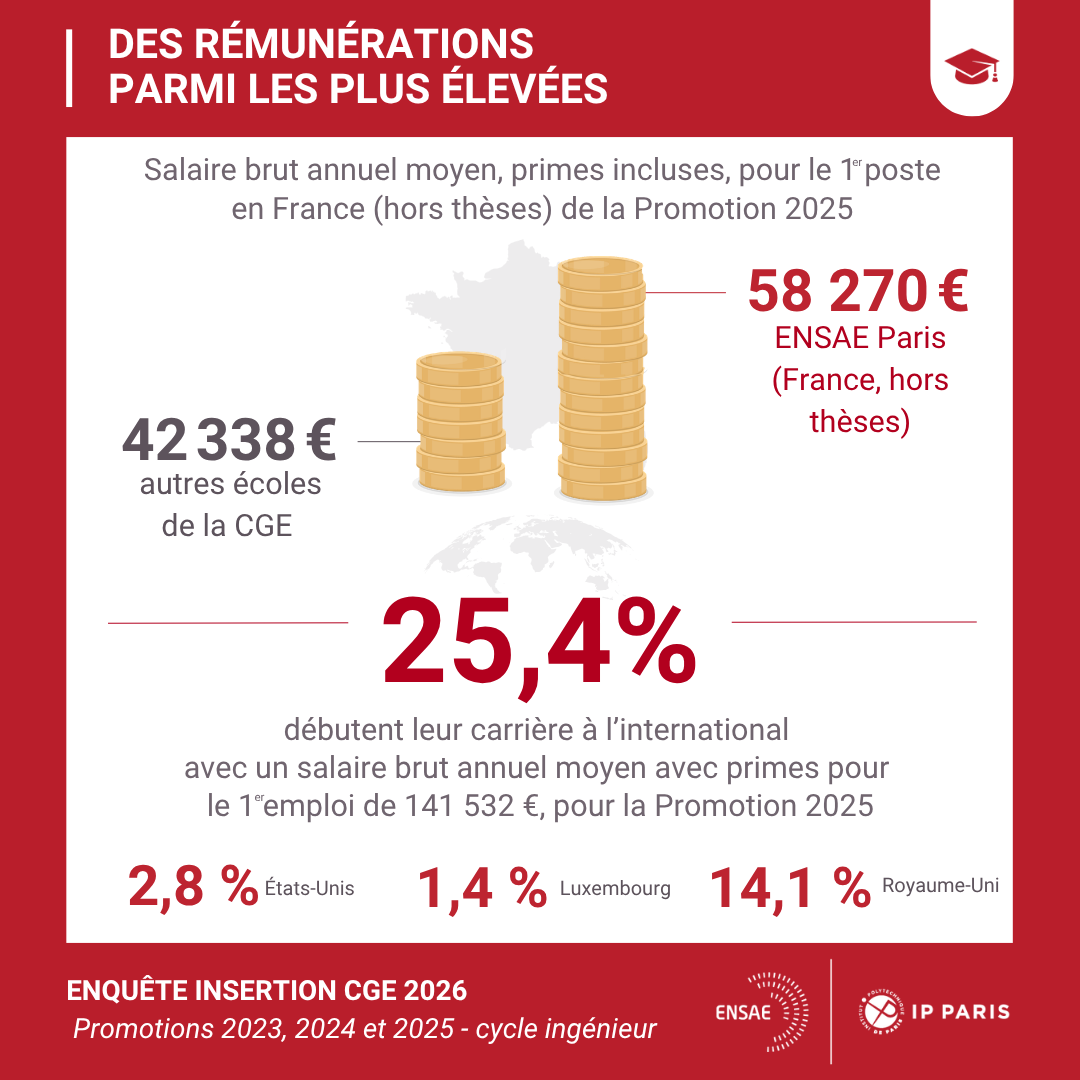
The share of graduates who start their careers abroad is 25.4% for the Class of 2025.
Across the last three graduating classes, 21% of our alumni are currently working abroad.
The most common destination for the Class of 2025 is the United Kingdom (14.1%).
The salaries of ENSAE Paris graduates remain among the highest among the top engineering schools.
For the Class of 2025 (excluding those pursuing doctoral degrees), the average annual gross salary, including bonuses, is €58,270 for jobs in France. Graduates’ salaries vary, sometimes significantly, depending on the industry, the specific role, and the location.
For recent graduates of the Class of 2025 in their first job in France (excluding those pursuing a thesis), the average annual gross salary, including bonuses, is €58,270—a level well above the average for CGE schools (€42,338).
For recent graduates taking their first job abroad, the average annual gross salary, including bonuses, stands at €141,532 for the most recent graduating class (2025), with significant variation in this figure as well.
None of the survey respondents from the Class of 2025 reported being dissatisfied with their job.
97% of engineers from the ENSAE Paris Class of 2025 who are currently employed report using generative AI in their work, compared to 75% across all engineering schools. The primary uses are primarily code generation, cited by 83.1% of respondents, followed by information retrieval (50.8%) and content creation (44.6%).
Results of the CGE 2023 Insertion survey